
Explosive exercise is the ability to generate maximum force in the shortest possible time—and it’s the quality that separates good athletes from truly dominant ones. Many competitors hit a frustrating plateau because they build strength but neglect power, the essential driver of speed, agility, and game-changing performance. This guide delivers a clear, technique-focused roadmap to help you safely integrate explosive movements, including plyometric workout routines, into your training. Drawing on proven athletic research and professional performance insights, we break down exactly how to convert raw strength into dynamic, competition-ready power—so you’re not just stronger, but faster, sharper, and more unstoppable in every arena.
The Science of Speed: Why Explosive Training Works
Explosive training isn’t just “moving fast.” It’s about teaching your body to produce force quickly.
Fast-twitch (Type II) muscle fibers are built for short, powerful bursts—like sprinting or jumping. In contrast, slow-twitch (Type I) fibers handle endurance tasks such as distance running. Explosive drills and plyometric workout routines primarily target Type II fibers, strengthening your ability to generate rapid, high-force contractions (think of a cat launching onto a fence in one fluid motion).
Then there’s Rate of Force Development (RFD)—the speed at which you can build force. It’s the true measure of explosiveness. Heavy lifts increase total force capacity, but jump squats and bounds train your nervous system to recruit fibers faster. In simple terms: strength is how much you can lift; power is how fast you can apply it.
Both matter. A heavy squat builds potential. A vertical jump proves you can use it. For athletes, combining both—plus targeted work like balance training exercises for rapid direction changes—creates real-world performance gains.
Years ago, I rushed into box jumps before I had any business leaving the ground. I thought speed alone would carry me. It didn’t. My knees ached, and my landings sounded like a drum solo. That lesson taught me this: earn your explosiveness.
First, strength is non-negotiable. Before attempting advanced plyometrics, build a base. A common benchmark is squatting 1.5x your bodyweight with clean form (a simple proxy for force production). Some argue you can skip this if you’re “naturally springy,” but strength is what protects your joints when gravity answers back.
Next, master the landing. Think of it as braking, not just jumping. Land softly on the balls of your feet, keep knees aligned with toes, and send hips back. This alignment distributes force safely (and keeps you off the injury list).
Finally, brace your core. Core stability—your ability to resist unwanted movement—transfers power from lower to upper body. Without it, energy leaks. Planks and dead bugs build that foundation. When you return to plyometric workout routines, you’ll feel the difference—quieter landings, higher rebounds, fewer regrets.
Build the base first, and the flash will follow. Your future joints will thank you for the patience. Trust the process. Always.
The Core Techniques: Your Arsenal for Power Development
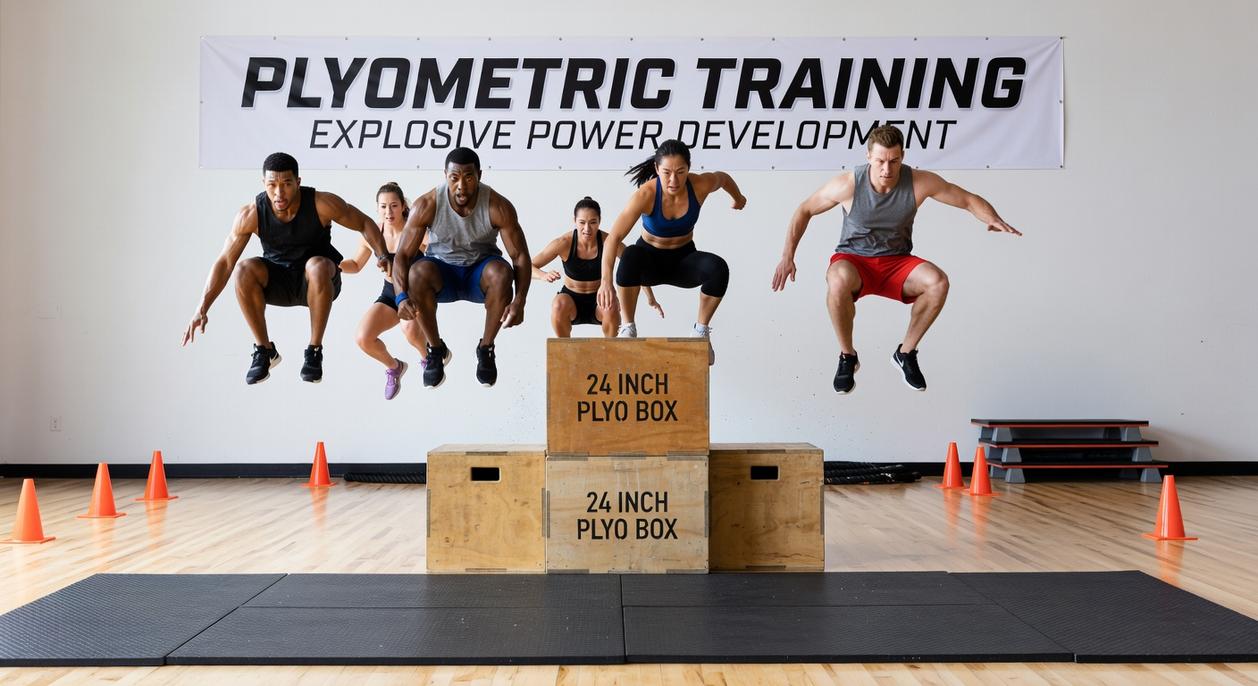
If you want more speed, higher jumps, and harder hits, you need movements that train power—not just strength. Power is force produced quickly. In sport (and life), that split-second matters. Think of the difference between casually tossing a ball and firing it like a quarterback in the final seconds of a championship game.
Here’s what’s in it for you: BETTER EXPLOSIVENESS, improved coordination, and more efficient movement patterns that carry over to real performance.
Category 1: Jumps (Plyometrics)
1. Box Jumps
Jump onto the box, not just over it. Focus on full hip extension—driving ankles, knees, and hips tall. Land softly in an athletic stance and always step down (don’t jump down). This protects your joints while reinforcing good mechanics. The benefit? Greater lower-body power with less wear and tear.
2. Broad Jumps
Drive forward for maximum horizontal distance. Use a strong arm swing for momentum and land solidly without falling forward. That “stick” builds balance and force absorption—key traits for sprinting and cutting.
Some argue jumps are risky. They can be—if done carelessly. But when coached well, plyometric workout routines improve tendon stiffness and reactive strength, both linked to sprint performance (Markovic & Mikulic, 2010).
Category 2: Throws (Ballistics)
Medicine Ball Slams
Explode through triple extension—ankles, knees, hips—then slam the ball with maximal velocity. This trains coordinated, full-body power. The payoff? Stronger acceleration and more forceful rotational movement.
Category 3: Lifts (Weightlifting Derivatives)
Kettlebell Swings
This is a hip hinge, not a squat. Power comes from the hips snapping forward—not the arms lifting the bell. Master this, and you build explosive posterior-chain strength.
Dumbbell Snatches
Lift in one fluid motion from floor to overhead, keeping the weight close. This develops speed, coordination, and unilateral strength (great for evening out imbalances).
Train these well, and you won’t just look athletic—you’ll MOVE like it.
Putting It All Together: Structuring Your Explosive Workouts
If you want real pop in your jumps and sprints, timing matters. Perform explosive movements at the very start of your workout, right after a dynamic warm-up. Your nervous system—basically the body’s electrical wiring that drives force production—is freshest then. Train power first, and you’ll feel the difference immediately.
Focus on quality over quantity. Aim for 3–5 reps per set and 3–6 total sets, attacking every rep with maximal intent (think “launch,” not “lift”). This approach boosts speed, coordination, and overall athletic carryover. Power thrives on precision, not fatigue.
Rest 2–3 minutes between sets. Longer breaks allow full recovery so each effort stays explosive—not sluggish.
For example, on a lower-body day, add box jumps before squats. On a full-body day, include medicine ball slams before presses. Integrated correctly, plyometric workout routines sharpen agility, elevate performance, and make every session more game-ready.
Incorporating plyometric workouts into your training not only enhances your explosive movement but also emphasizes the importance of ensuring your protective sports equipment is in top shape for optimal safety during these high-intensity sessions, as discussed in our article on Extending the Lifespan of Protective Sports Equipment.
From Potential to Power: Your Next Move
True athletic power starts with strength—but it only comes alive when refined by flawless technique. If you’ve been building strength without seeing it translate to the field or court, that’s your missing link. Without speed and explosive intent, your hard-earned gains stay trapped in the weight room.
By mastering foundational jumps, throws, lifts, and plyometric workout routines, you train your body to produce force quickly and efficiently. Start simple. Own one movement—like the box jump—and focus relentlessly on a controlled, precise landing before progressing. Dial it in, build from there, and turn your potential into undeniable power.